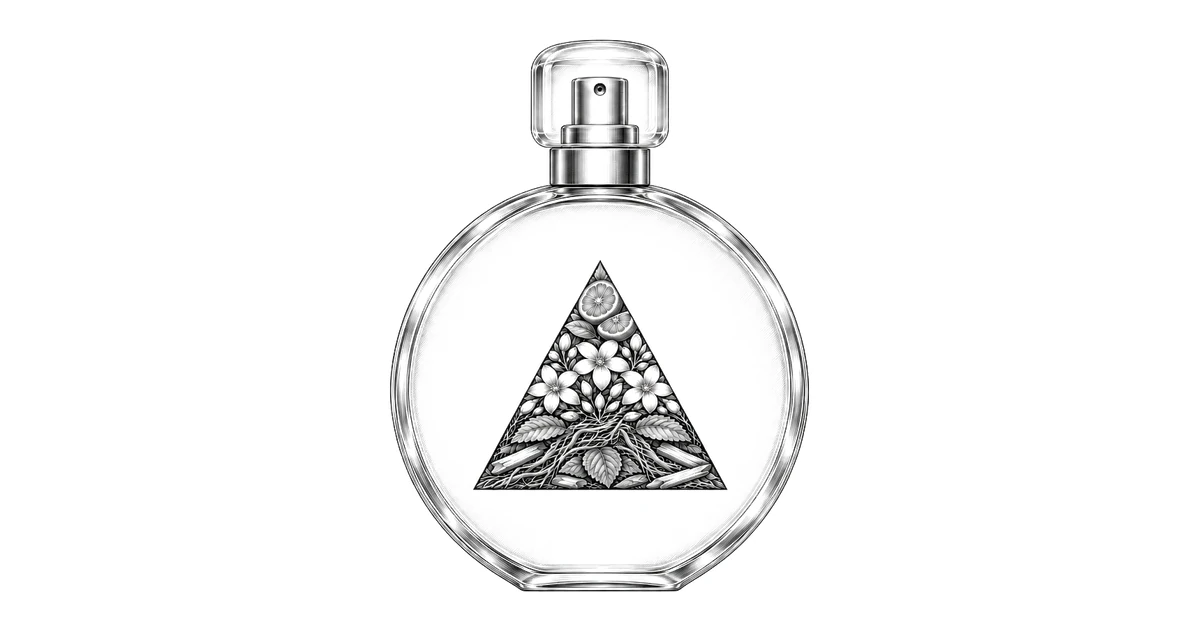
A note pyramid will tell you how a fragrance shifts from morning to night, but it says nothing about what the perfume is made of or how it will wear on your skin. And the part that matters most is hiding exactly where you would never think to look.
I dab a perfume on my wrist and raise it to my face. Within a minute I know it is love at first breath, what the French call a coup de foudre. By evening a different scent has settled on my skin, quieter and cooler, and I regard my own wrist with a faint, familiar disappointment. That is simply how perfume behaves, and sulking about it gets you nowhere. What puzzles me is that we still choose our perfumes from three lines of copy, in which bergamot politely hands over to jasmine and jasmine, just as graciously, to sandalwood.
Where does the note pyramid come from?
The division into top, middle and base notes is usually traced back to the French perfumer Jean Carles. In 1961 he laid out a method for beginners, and I love that it began with nothing grander than a strip of paper. You put a drop of a material on it, noted the time and waited, patiently, for the moment the scent lost its character, and that way you learned what vanished almost at once, what held on for a few hours and what clung to the paper until the next day.
There is no pyramid in his text, not even the word, just a table of materials ranked by how quickly they evaporate. It was a working notebook for the person who composes a perfume, and I still can't work out when it became a promise to the person who buys one.
What did Carles think of the first few minutes?
Carles thought the top note fairly important, though for a reason that still makes me laugh. Its job is to make the perfume smell pleasant the instant you open the bottle, because the buyer is easily swayed by that first impression, "with or without reason". The character of a perfume, he adds, is never decided by the top note.
The base decides it. And the base, whatever the pyramid suggests, does not stand in line waiting for its turn. Vetiver and patchouli are there from the very first second, and on a freshly dipped strip they smell rather unpleasant, which is why Carles softened them with materials of medium tenacity. He called those materials, with no poetry whatsoever, modifiers. Everything you smell in those first minutes is already the fruit of that work, a dressed-up opening laid over whatever will stay with you until night, on the collar of your sweater and on your pillow.
Why don't notes keep to a schedule?
No one assigns each note its hour in advance, because the materials in a perfume act on one another. In 2003, researchers measured how fragrance compounds evaporate from skin. The very same mixture of 12 materials behaved differently alongside a musk, which holds the scent back, than it did without one. Bergamot doesn't clock out on the hour, it lingers or slips away depending on the company it keeps, and in that it resembles me more than I would care to admit.
A note is an image, not the contents of the bottle
When I read the words "lily of the valley", I picture the flower itself shut up inside the bottle. Yet lily of the valley happens to be the perfect example of the opposite. Nobody extracts it on an industrial scale. The spring scent that sets my head spinning every May is pieced together by perfumers from synthetic molecules. A note tells you what a perfume smells like and says nothing of what it is made of. Nor will the label help you: a single word, Parfum, often stands in for the entire formula.
Sometimes there is no pyramid at all. Escentric Molecules describes Molecule 01 as one single molecule, Iso E Super, which simply cannot be divided into top, heart and base. And yet, the brand insists, its scent keeps slipping away and coming back, and in that I recognise a few men from my own life.
How should you read the notes?
I'm not asking you to throw the pyramid away. It is good at pointing you in the right direction, and if you love iris and vanilla, that is where to start, rather than with whatever happens to sit on the shelf by the door this week. Just read it as an invitation: put the perfume on your skin, take your time, resist deciding too soon, and live with it for a whole day. Whatever is left on your wrist and your collar by evening is your fragrance, and I have tested that on myself more than once.